
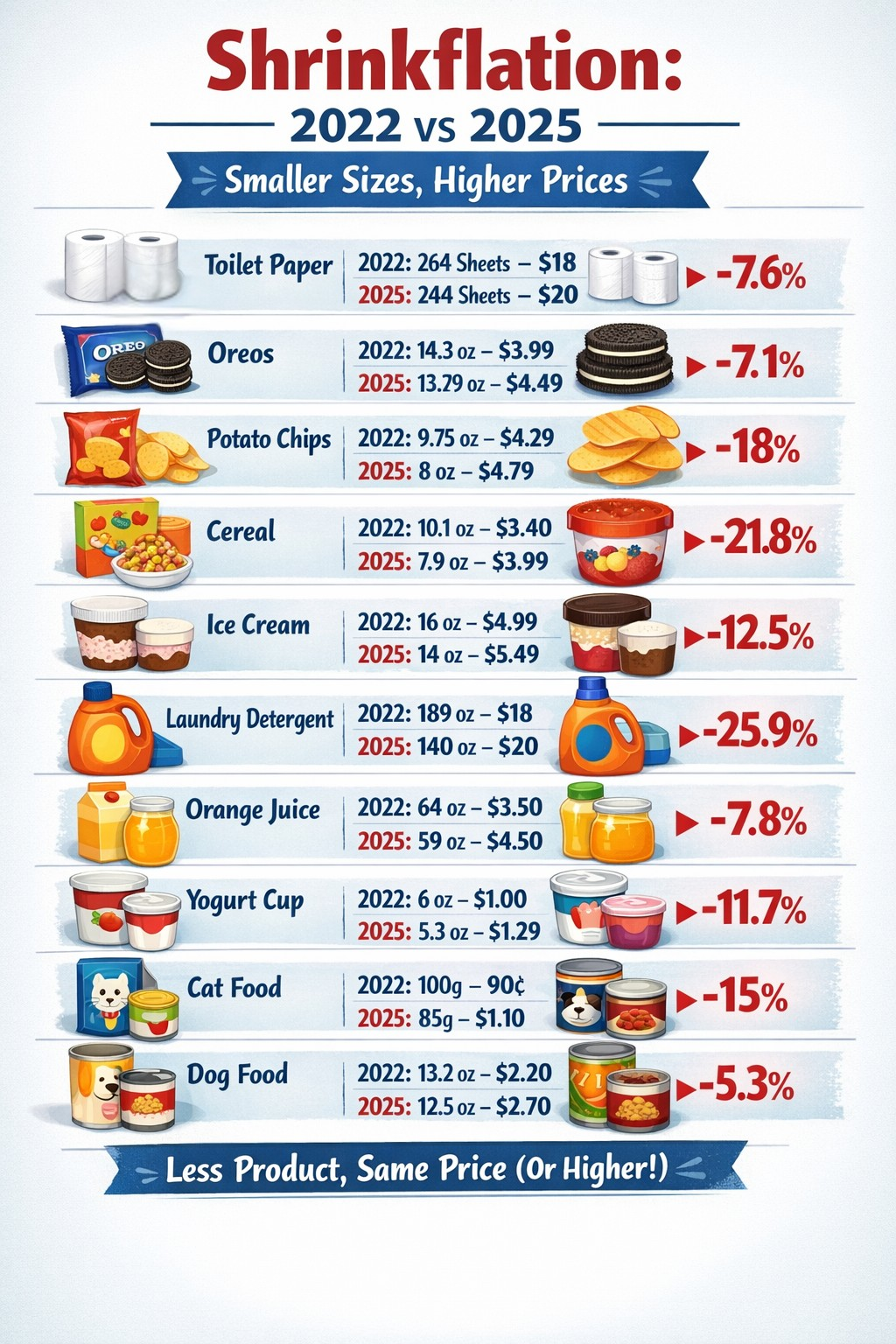
Shrinkflation examples are becoming easier to spot in everyday products.
In my recent post, When Everything Feels Smaller, we talked about groceries and household goods. We discussed how many everyday items seem to be shrinking. Meanwhile, prices continue to rise.
Have you ever opened a bag of chips and wondered why it looks half full? Or noticed a roll of paper towels running out faster than it used to? You’re not imagining things.
The numbers tell the story.
👉 If you missed the original reflection, you can read it here: When Everything Feels Smaller
Shrinkflation is Real
Shrinkflation occurs when companies reduce the size or quantity of a product. They keep the price the same or even raise it. Instead of increasing the price dramatically, manufacturers sometimes shrink the package so the change is less noticeable on the shelf.
According to consumer price research from the Bureau of Labor Statistics, the organization tracks pricing trends. This is done through the Consumer Price Index (CPI). Manufacturers often adjust packaging size and pricing strategies. They do this as production and supply costs change.
Over time, those small reductions add up.
Real Examples of Shrinkflation (2022–2025)
Shrinkflation examples comparing product sizes and prices between the years 2022 and 2025.
| Product | 2022 Size | 2025 Size | 2022 Price | 2025 Price | % Size Change | % Price Change |
|---|---|---|---|---|---|---|
| Toilet Paper | 264 sheets | 244 sheets | $18 | $20 | -7.6% | +11.1% |
| Paper Towels | 133 sheets | 121 sheets | $2.00 | $2.25 | -9.0% | +12.5% |
| Oreos | 14.3 oz | 13.29 oz | $3.99 | $4.49 | -7.1% | +12.5% |
| Potato Chips | 9.75 oz | 9.25 oz | $4.29 | $4.79 | -5.1% | +11.7% |
| Cereal | 10.1 oz | 7.9 oz | $3.40 | $3.99 | -21.8% | +17.3% |
| Ice Cream | 16 oz | 14 oz | $4.99 | $5.49 | -12.5% | +10.0% |
| Yogurt Cup | 6 oz | 5.3 oz | $1.00 | $1.29 | -11.7% | +29.0% |
| Orange Juice | 64 oz | 59 oz | $3.50 | $4.50 | -7.8% | +28.6% |
| Laundry Detergent | 189 oz | 140 oz | $18 | $20 | -25.9% | +11.1% |
| ToothPaste | 6 oz | 5 oz | $3.50 | $4.29 | -16.7% | +22.6% |
| Cat Food | 100 g | 85 g | $0.90 | $1.10 | -15% | +22.2% |
| Dog Food | 13.2 oz | 12.5 oz | $2.20 | $2.70 | -5.3% | +22.7% |
When you look at the numbers side by side, a clear pattern appears.
These products didn’t just shrink — their prices increased at the same time.
When quantity decreases while prices rise, the real increase is often much larger than it first appears. Consumers are paying more per unit of product. In some cases, the increase is 30–50% higher than it was just a few years ago.
Some changes are easy to miss. A toothpaste tube that once held six ounces may now hold closer to five. The difference doesn’t look dramatic on the shelf. Over time, many households notice products running out sooner than they used to.
Why Companies Use Shrinkflation
Companies face rising costs for:
• ingredients
• packaging
• transportation
• manufacturing
Instead of dramatically increasing prices, companies sometimes reduce the amount inside the package. The product may look nearly identical on the shelf, but the quantity inside is smaller.
For households, however, the result feels the same.
We end up paying more while getting less.
There is also another part of the conversation that people are talking about more openly today — corporate greed. In some cases, companies discover that consumers will continue buying products even when the package quietly shrinks. When that happens, shrinkflation can become less about survival and more about protecting profit margins.
Manufacturing trends also play a role. Over the years, more production has moved outside the United States. While global manufacturing can reduce costs for companies, it can also create longer supply chains and less transparency for consumers. Many people are beginning to feel that bringing more manufacturing back to the United States isn’t just about economics. It’s also about stability, quality, and accountability. When products are made closer to home, there is often greater transparency in how they are produced and packaged. Supporting American manufacturing can help strengthen local communities. It can protect jobs and encourage companies to focus on long-term value rather than short-term profit. Choosing products made in the United States may be a small decision. However, it can be a meaningful way for consumers to push back against shrinking products and rising prices.
Shrinkflation may start with rising costs. However, companies’ decisions about pricing, packaging, and production ultimately determine how those costs affect consumers.
In the same way shrinkflation quietly changed what we buy, where products are made has quietly changed too. Paying attention to both may be one way consumers can encourage companies to value quality, fairness, and responsibility again.
Why It Feels Like Everything Is Getting Smaller
Shrinkflation rarely happens in just one category.
It affects many parts of everyday life:
• groceries
• snacks
• paper products
• cleaning supplies
• pet food
When many products shrink at the same time, families begin to notice something feels different.
Packages look the same.
But they run out faster.
The Bigger Picture
Statistics can explain shrinkflation.
But what people notice most is the everyday experience.
Opening a package and realizing it’s smaller than it used to be.
Trying to stretch groceries a little further each week.
Watching household essentials slowly change over time.
If this topic resonates with you, you might enjoy the reflection that started this conversation.
👉 When Everything Feels Smaller
I’d Love to Hear From You
Have you noticed shrinkflation where you live?
What products seem smaller than they used to be?
Share your observations in the comments — your experience might help someone else realize they’re not imagining it.
💌Join Our Journey
If these reflections speak to your heart, we’d love for you to walk this journey with us.
We send a gentle note whenever a new post goes live. There is no spam. Just cozy reflections, seasonal moments, and encouragement along the way.
With love,
Wanda & Kim
Mom and Me Moments 💛
Until our moments bring us together again—make every moment meaningful.